
by Charles Henderson
For most of the past year, I have focused on improving myself. First of all, health with major weight loss and a complete change in my nutrition and exercise. I found that getting my hormones, metabolism and physical fitness in balance greatly enhanced my mental health. However, I could not find the Joy I once had.
My Christian faith is supposed to bring joy to the heart, but I watched the news and it not only depressed me but really pissed me off. Who are these idiots? We are surrounded by idiots! Idiots lead the nation in Congress and the White House.
I also started missing a lot of Sundays in church. I am a member of the Cross Fellowship Church, Black Forest, Colorado, a Southern Baptist denomination, so-to-speak, although today we believers in Jesus do our best to shed the trappings of denomination with its parochial walls and rules made by men, not God. Something that Jesus openly criticized, calling the Pharisees a “brood of vipers.” They made rules that were of men not God and enforced them with cruelty. I am wholeheartedly with Jesus, laws carved in stone and judged with cruelty are not the Laws of God but man and cause humanity to suffer. You will go to Hell if you don’t go to the church with the correct sign over the doorway. Yet Jesus did not see His Church as a building but as People, God’s Children. Jesus LOVED.
Okay, so I found myself missing church a lot of Sundays, and realized that part of my good physical health but deep unhappiness grew from my not being there on Sunday, studying the Bible in my “Life Group,” Grace Applied, today’s generation’s name for Sunday School. Being with my Christian family, the Congregation, and my close family, my Life Group. It was uplifting to my spirit to be there Sunday and carried me through the week. I felt the twinkling of Joy.
However, something else failed me. Darkness crept around my corners. And the darkness got worse with the volume of Fox News or CNN I watched. Also I watched ABC News and CBS and NBC. Plus I read the major published newspaper websites too, The New York Times, Wall Street Journal, Washington Times, Washington Post, Colorado Springs Gazette. I wanted to find balance and somewhere in the biased reporting I might find a glimpse of truth. Today, true journalism is dead. It’s all advocacy propaganda and spin now. Reporters take sides and focus on politics. Politics, the bane of humanity. The disease that brings darkness, starts wars and fosters hate.
I am hard-pressed to find any element of politics that fosters love. Unless you regard the Reverend Doctor Martin Luther King a politician. I do not. He led a crusade to exact freedom for all people. King based his whole ideology on Jesus Christ’s Sermon on the Mount. One can read it in the Book of Matthew, chapters 5 through 7. Many famous quotes from Dr. King are paraphrases of something Jesus taught.
Scripture in Matthew 5:43-48 says: 43 “You have heard that it was said, ‘Love your neighbor and hate your enemy.’ 44 But I tell you, love your enemies and pray for those who persecute you, 45 that you may be children of your Father in heaven. He causes his sun to rise on the evil and the good, and sends rain on the righteous and the unrighteous. 46 If you love those who love you, what reward will you get? Are not even the tax collectors doing that? 47 And if you greet only your own people, what are you doing more than others? Do not even pagans do that?48 Be perfect, therefore, as your heavenly Father is perfect.”
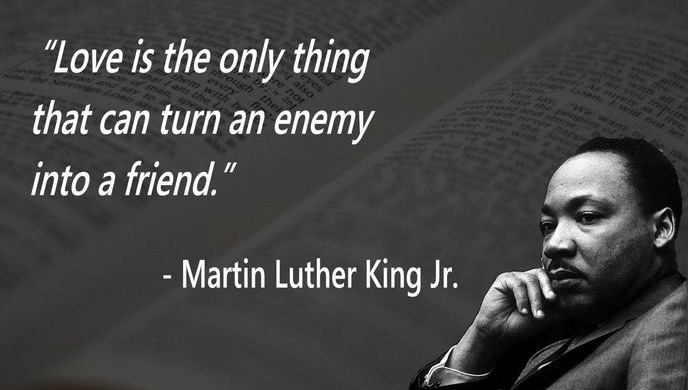
Dr. King spoke at length about the difficult chore of turning hatred into love, and how we should love our enemies. That Love is the only thing that can turn an enemy into a friend.
On November 17, 1957, Dr. King delivered an eloquent sermon at the Dexter Avenue Baptist Church in Montgomery, Alabama. His sermon focused on Love and Loving Your Enemy. The entirety of that sermon is available at this link from Stanford University, King Institute archives: https://kinginstitute.stanford.edu/king-papers/documents/loving-your-enemies-sermon-delivered-dexter-avenue-baptist-church
I wish that Dr. King was with us today. I wish that the Reverend Doctor Billy Graham was with us today. We need a champion to again teach humanity the meaning of Agape, the highest form of Love. “No greater love hath a man than to lay down his life for his friend,” Jesus told His disciples at The Last Supper. Christ also knelt on the floor with a basin and pitcher of water and washed the feet of His disciples, demonstrating His love, by serving them. Humbly Giving.
Agape Love is giving without condition, serving selflessly, sacrificing for others, unconditional commitment to the well-being of others. Loving others as God loves humanity. Trying to Love like God Loves.
Maybe Jesus might show up or bring us a champion for Agape Love and Peace and teach us all to Love each other and cast away the darkness of hate that seems to cover our nation, and our world today. Give us a champion for Agape Love, but keep us from killing him?
We seem to kill these guys without fail. People like Dr. King. People who preach Love and teach us to Love our Enemy and Pray for those who Hate Us.
Darkness greatly dimmed my outlook on America and the world when the people who hate God, who reject Jesus, who hate everything that echoes Christ’s commandment to Love One Another, and they call the Love Hate and Bigotry. The people who embrace chaos and darkness instigated a man consumed in their politics to murder Charlie Kirk. To kill a man who stood up for Jesus and sought to bring the Gospel of Christ to the very people who hated him most.
The killing of goodness dates back to the killing of the Prophets, the killing of Jesus, the killing of so many others who preached love and peace, like Martin Luther King or, yes, Charlie Kirk too.
The days following Charlie Kirk’s death troubled me because a growing chorus of people opposed to his conservative Christian values began to argue that the young Mister Kirk had brought his death upon himself, and by dying so publicly, he had also committed an atrocity that somehow needlessly traumatized the people who furiously hated him and saw him die.
I felt a great well of anger fill deep in my heart because of the hate that killed a man who preached love.
Idiots!
While millions, including presidents and world leaders, gathered to honor and memorialize Charlie Kirk, millions of others likewise hated it.
Darkness spread, and I believe that Satan laughed while Angels wept.
I wept.
I wept for my country and all our people, our American people, and I wept for people from other nations here, good and bad, here illegally for all reasons good or bad. I wept for everyone because God loves them all and wept for them too.
This sadness and this anger stayed with me, eating at me darkly. Church did a little good but I needed more. I needed to work on my soul the way I had spent the entirety of 2025 working on my physical self. My spiritual self needed the same level of fitness too.
Most recently, the federal fraud investigations and the Immigration and Customs Enforcement operations in Minnesota and other so-called, Sanctuary States (states that offer safe-harbor for immigrants in the United States illegally) have spread hatred to the greatest depth that I can recall. Even during the Vietnam War, I cannot remember such anger-fueled hatred. Hatred to the point of murder and bloodshed.
The kind of hate that murdered John F. Kennedy, Robert F. Kennedy and Martin Luther King in the 1960s, but today far worse and more widespread.
This level of hate, of angry divisions of ideas, of Bloody Politics, spread even into the hearts of people I love as dear friends, and to the hearts of family too. And it spread into my heart, motivating me to make harsh statements critical of those who have political opinions polar opposite of my own.
Satan truly is happy now!
After one person who I very greatly respect, whom I regard as a friend as well as a colleague, lashed out at me, critical of a statement I made, struck me deep. His words stung, and I felt anger boiling in me while preparing to justify my position and tell him how blindly stupid he is to not see the truth. My truth. But truly my biased perspective of what I believe is true.
I said nothing. I held it back. Perhaps God’s Holy Spirit put His hand on my heart and told me to just be quiet for a while. Let my perspective correct itself. Let God adjust my vertical and horizontal holds on how I see things.
One thing that is definitely true goes back to the words of Jesus in His Sermon on the Mount, and Dr. Martin Luther King’s sermon in the Dexter Avenue Baptist Church in Montgomery, Alabama, November 17, 1957, when he used what Jesus said in the Book of Matthew, chapter 5, verses 43 through 48, as the foundation of one of the greatest sermons Dr. King ever preached.
LOVE YOUR ENEMY!
Is my friend who sharply and publicly criticized what I said my enemy? The thought of it hurt deep in my heart. My friend is a gifted human being, brilliant and filled with knowledge, and a creative genius with words. He is NOT my Enemy! Yet, for a while, I felt like he was my enemy.
This instance of my friend evoking the idea that he was my enemy is at the heart of what is wrong in America today. Bloody Politics! Yes Bloody!
Bloody Politics sparked the Civil War.
Yes, slavery anywhere in our lives is evil and an abomination in every respect and we cannot tolerate it. But we do. Women, children, girls and boys are trafficked across North and South America by the thousands, and these people are slaves. We tolerate it because we don’t see these people, even though we encounter them as they cower in the shadows, cleaning up our mess we leave behind. Doing the hard labor. Brought here with lies, illegally trafficked, and put to work illegally. Their masters collecting the pay for the slave labor as contractors who hustle these poor souls to and from the work sites daily. Some of them working as prostitutes, others working as laborers and midnight cleaners. All of them kept in the shadows. The Civil War killed nearly a million Americans, brothers against brothers, but it did not end slavery. It just cast darkness over it and slavery continues today, just as it has continued since the beginning of civilization.
But the hate sparked the war, first with Red-Leg Kansas attacking and burning Bloody Missouri in the 1840s and 1850s, then John Brown, the Emancipation Proclamation, the secession of Southern States, Civil War, and nearly a million people died.
Why did the people hate? Simply put, Bloody Politics. One side wants people to live in a collective. Others want to take the wealth and divide it among the population. Others want wealth gained by free enterprise and innovation. Others want freedom to live as they wish while others want a single master to control all life. And there are perspectives between every extreme view.
Just as the color of human skin, political ideas have the same subtle shades that go from one end to the other of the scale without a distinguishing single line. Politics tend to blend across the spectrum of ideas, just as skin color subtly blends across the spectrum of darkest brown to palest white, a translucent pink. The notion of Race is a politically-driven stupid idea! Just as most politics held by people take us to some stupid beliefs.
Then as I deeply considered these evils–race, politics, hate, anger, judgment–I began to understand that allowing these evils to affect my perspective of others cause not only the other people to whom I expressed my hatred, my anger, my superior ideas and attitudes that painfully contradicted their beliefs, that the same evil hurt me too. Badly hurt me. The evil of hate, Bloody Politics, had robbed me of my joy.
I quit watching Fox News and CNN, and barely caught local news for mostly the weather and the sports news. But that did not make me joyful. Jesus’ Sermon on the Mount told me what I needed to do.
Jesus said, Love thy Neighbor. And go even a step father and Love Thy Enemy! Do Good to those who Hurt You. Pray for those who will kill you. Do not hate but Forgive! LOVE!
How do we love our enemy? We take our hate out of our hearts. Truly, remove the hate. Fill our hearts with light, the Light of the World. LOVE.
Stop for a moment and consider that the person who fumes his or her hate at you is also a person who has the capacity to love you back. He or she is a human that has qualities that will give us joy. God is Love and created humanity with Love. Even the worst of us have the capacity to Love.
I found myself feeling sad when I considered that I had avoided watching a motion picture because a certain actor played in the film and I disagreed with his or her extreme politics. Not even extreme politics, as it turned out. Just politics that opposed my politics.
Last night, I watched The Accountant 2, starring Ben Affleck and Jon Bernthal. I loved the movie. Yes. I am a Marine and I use Crayons and I am easily entertained. Give me gunslinging violence, but the good guys winning, saving the children from murder, freeing the slaves. I love it!
Then I thought about Robert De Niro, a great American actor that I really enjoyed in so many motion pictures. I want to be Bad Grandpa! His politics are his to own, not mine. So let’s get past it. I enjoy laughing at the comedy and I capitalize on the goodness and cheer.
What makes America great, or did until Bloody Politics and Hate took over our lives, is that we can disagree in our beliefs but still love our neighbors. Because we see all the wonderful goodness and we let go of the idiotic ideas they have. Maybe they have to let go of my ideas that they regard as idiotic too?
George C. Scott made a better General Patton than General Patton did of himself. Yet the politics of George C. Scott spun in low orbit over a far horizon; far, far from my conservative Christian perspective.
Our friends and neighbors, our loved ones, never fully agree with us, so don’t hold it against them. Say, “You’re an idiot but I love you anyway and you can have your idiotic ideas. Just allow me to have my own idiocy.”
When I watch a Three Stooges comedy, or a Mel Gibson action film like Mad Max or Lethal Weapon (all sequels included), I embrace the character he plays and not the man behind the mask. The same for Robert De Niro. Taxi Driver or Bad Grandpa or Ben Stiller’s father-in-law, I want to let go and give myself the freedom to like him. The joy to fill my heart. The light to cast out all darkness.
I want to give myself the freedom to also like my friend who criticized my viewpoint, basically calling me an idiot. I can say, “You’re an idiot too. And we can both just shrug it off because our idiot opinions mean nothing! Our brotherly LOVE means EVERYTHING!”
Even strangers need to be loved. They may hold signs that proclaim what I regard is idiotic, but that’s just a sign, and that’s just a political statement driven by today’s Bloody Politics.
We must make ourselves see the people holding the signs. See that they are children of mothers and fathers who love them, who gave them life. They are children created by God who Loves them greater than we humans can even know.
Put an end to Bloody Politics and See the People. Love them. They are not the enemy, even if our Bloody Politics brands them as the enemy.
As Jesus preached and as Dr. Martin Luther King said, “Love is the only thing that can turn an enemy into a friend.”
And that’s the Truth!






 Road Kill Stew